
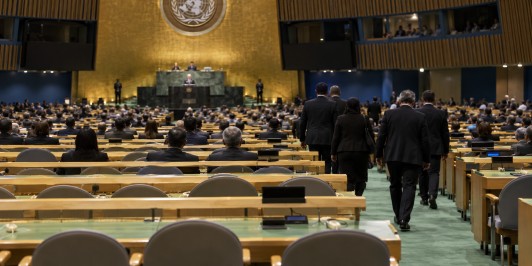
The tension between the United States and both Iran and Cuba was highlighted on September 22 when representatives from these nations exited the United Nations General Assembly session in protest. The walkouts occurred during U.S. President Donald Trump’s speech, where he sharply criticized both countries’ policies and governance.
As Trump addressed the assembly, he emphasized the ongoing challenges posed by Iran, focusing on U.S. military operations and the potential for further action if a diplomatic agreement is not reached. This prompted the Iranian delegation to leave the chamber. Notably, Iranian President Masoud Pezeshkian and Foreign Minister Abbas Araghchi were in New York for the UN event but were absent during Trump’s remarks.
In his speech, Trump presented a dichotomy for the United States: either reach an agreement with Iran or consider further measures against the Islamic Republic. He also called on other nations to bolster economic pressure on Tehran to address international concerns over its policies.
Similarly, Trump’s comments on Cuba led to the departure of the Cuban delegation. Describing Cuba as a “failed state,” Trump articulated his administration’s stance on seeking significant changes on the island. He declared that freedom would eventually come to Cuba and warned against foreign powers establishing a foothold there, reinforcing a hardline approach.
The incidents of protest underscored the strained relations between the U.S. and these countries. Trump’s address, which tackled various international issues, highlighted the administration’s firm policies on Iran and Cuba before the global audience at the UN General Assembly.